Description
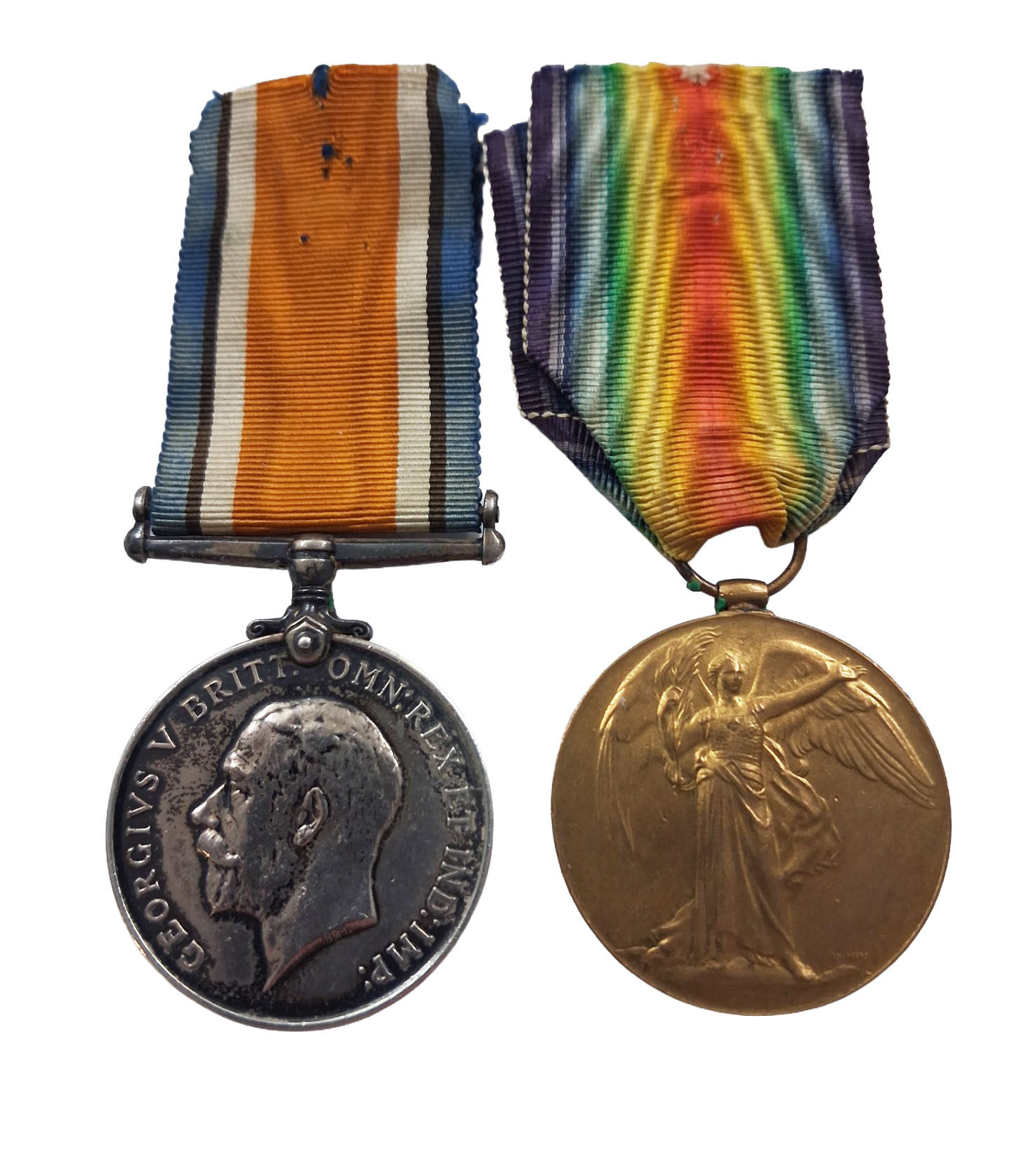
A Royal Navy Battle of Jutland, H.M.S. Duke of Edinburgh, Pair awarded to Ships Cpl 1 (Yeoman of Signals), “Coder” Charles Carbin Royal Navy comprising 1914-1920 British War and Victory Medals, (202583C. Carbin. Shps. Cpl. 1 R.N.), toned very fine.
Ships Corporal Carbin is also entitled to the 1914-15 Star.
Jutland H.M.S. Duke of Edinburgh
When the British began to prepare for war in July 1914, Edinburgh was refitting in Malta. Her refit was cut short, and she joined the rest of her squadron in the southern approaches to the Adriatic. She was involved in the pursuit of the German battlecruiser Goeben and light cruiser Breslau at the outbreak of World War I but was ordered not to engage them. On 10 August Duke of Edinburgh and her sister ship Black Prince were ordered to the Red Sea to protect troop convoys arriving from India. While on that duty the ship captured the German merchantman Altair of 3,200 tons on 15 August. While escorting a troop convoy from India to France in November 1914, Duke of Edinburgh provided cover to three battalions of infantry that seized the Turkish fort at Cheikh Said at the entrance to the Red Sea. The ship then landed a demolition party, which blew the fort up on 10 November; she then re-joined the convoy.
Duke of Edinburgh re-joined the 1st Cruiser Squadron, which had been transferred to the Grand Fleet in the meantime, in December 1914. In March 1916 the ship had her main deck 6-inch guns removed and the openings plated over. Six of the guns were remounted on the upper deck, three on each side, between the wing turrets, protected by gun shields.
At the Battle of Jutland on 31 May 1916, the 1st Cruiser Squadron was in front of the Grand Fleet, on the right side. At 5:47 p.m. The two leading ships of the squadron, the Flagship H.M.S. Defiance, and H.M.S. Warrior, spotted the German “nd Scouting Group and opened fire. Their shells felt short, and the two ships turned to port in pursuit, cutting in front of the battlecruiser H.M.S. Lion, which was forced to turn away to avoid a collision. Duke of Edinburgh could not follow the first two ships and turned to port (northeast). The ship spotted the disabled German light cruiser SMS Wiesbaden at 6:08 and fired twenty rounds at her. By about 6:30 she had steamed to a position off the starboard bow of H.M.S. King George V, the leading ship of the 2nd Battle Squadron, where her funnel smoke obscured the German ships from the foremost dreadnoughts of the 2nd Battle Squadron. A torpedo attack by German destroyers on Admiral Beatty’s Battlecruiser, failed, but forced Duke of Edinburgh to evade one torpedo at 6:47. The ship reported a submarine sighting at 7:01, although no German submarines were operating in the area. She fired at another false submarine contact between 7:45 and 8:15.
After the battle, Duke of Edinburgh was attached to the 2nd Cruiser Squadron and remained at sea until 2 June, searching for disabled ships. She arrived in Scapa Flow on the afternoon of 3 June.
Charles Carbin was born in Bishop’s Frome, Hereford on the 18th of June 1883 AN Errand Boy by trade. He joined the Royal Navy on the 18th of June 1901 for 12 years Engagement, he served abord 25 Ships during his Royal Navy career joining H.M.S. Duke of Edinburgh on the 3rd of March 1914 and leaving the ship on the 3rd of August 1918. He was a Yeoman of Signals, and his trades are given as Signaller, telegraphist and Coder. His last rank was R.P.O. (Sigs) he was discharged to shore on the 2nd of September 1920.
Sold with Copy Service papers and Copy Medal Roll showing entitlement to a 1914-15 Star.